

Symmetry#
The Info panel#
The symmetry reported depends on the periodicity of the structure:
Structure |
Symmetry |
|---|---|
crystal (3D) |
space group |
slab (2D) |
layer group |
polymer (1D) |
rod group |
molecule (0D) |
point group |
The panel also reports the point group, the lattice parameters, the cell volume or area, the density and the formula. All of them are recomputed when the structure is edited.
Point symmetry analysis#
Cell → Point symmetry analysis lists the symmetry elements of the structure — rotation axes, mirror planes and inversion centres — and draws them in the view.
The operators are named in the Schoenflies notation used in chemistry: C2, C3, C4 and C6 for the rotation axes, S4 and S6 for the rotoreflection axes, σ for a mirror plane and i for a centre of inversion. The mirrors are distinguished where the group allows it: σh perpendicular to the principal axis, σv containing it, and σd bisecting the two-fold axes across it. A group with no single principal axis — the orthorhombic ones, whose three two-fold axes are equivalent — keeps the plain σ.
The group itself is reported in the convention of its own kind: a space group or a layer group in the Hermann–Mauguin notation, a molecular point group in the Schoenflies one.
Reducing the symmetry#
A calculation is sometimes run in a symmetry lower than that of the ideal structure: to allow a distortion to relax, to remove a degeneracy, or to converge a particular magnetic state.
The Reduce symmetry… button of the point-symmetry panel removes point-symmetry operators. The subgroups generated by the operators that remain are then listed:
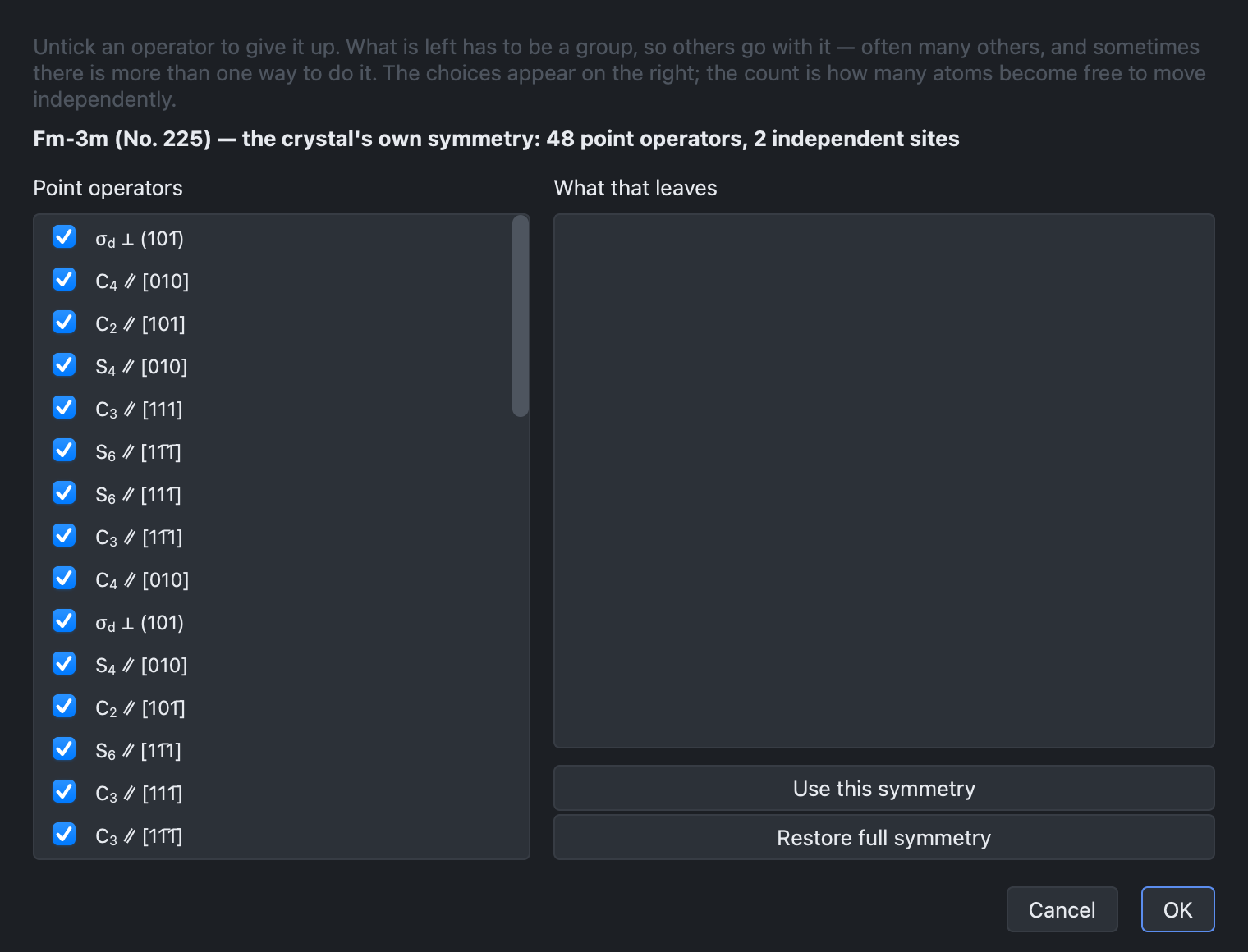
Subgroups that cannot be written in a CRYSTAL deck are listed in grey rather than omitted. Each candidate is verified by reconstruction: the operators are multiplied out and the structure is rebuilt from them, so that a subgroup is offered only if it regenerates the crystal.
The reduction applies to the structure itself. The Info panel reports it under Treated as, and the decks written afterwards use it.
Slabs#
The symmetry of a slab is a layer group, one of the 80. The direction normal to the slab is not a lattice vector, and treating the structure as three-dimensional would count the vacuum as one.
The layer group is determined with the aperiodic direction placed along c, as CRYSTAL expects, with the layer centred in the cell, and is verified by rebuilding the slab from it before use. The deck is then written in that layer group, with only the asymmetric unit listed; see CRYSTAL input builder.
Symmetry reduction is not available for slabs, and the dialog reports the reason: a layer group is not a space group.