

First steps#
Opening a file#
File → Open… (Ctrl+O) reads a CRYSTAL output (.out), a geometry
file (.gui, .34) or a crystallographic information file (.cif). A file
dropped on the window is opened in the same way.
If the output contains a vibrational calculation, the modes are read with it. If it does not, the geometry alone is shown and the remaining functions are unaffected.
Working in the calculation’s folder#
CRYSTAL writes more than the output file. A properties run leaves BAND.DAT,
DOSS.DAT, fort.25 and their named variants; an anharmonic run leaves
ANSCANWF.DAT; the decks that produced them stay as .d3 files.
CRYSTALLine looks for these beside the output that is open, and works better when they are all in one folder:
The Electronic bands & DOS dialog lists the band and density-of-states files it finds there, recognises them by their contents rather than their names, and pairs a band structure with a density of states computed from the same SCF.
It also reads the
.d3deck that produced the path, which is where the names of its corners come from — a band file records coordinates, and for some paths not even those.The file dialogs of the other plots open in that folder.
Anharmonic wavefunctions are found without being asked for.
So keeping a calculation and everything it produced in one directory, rather than moving the output somewhere on its own, is what allows the program to offer the right file instead of an empty dialog.
The main window#
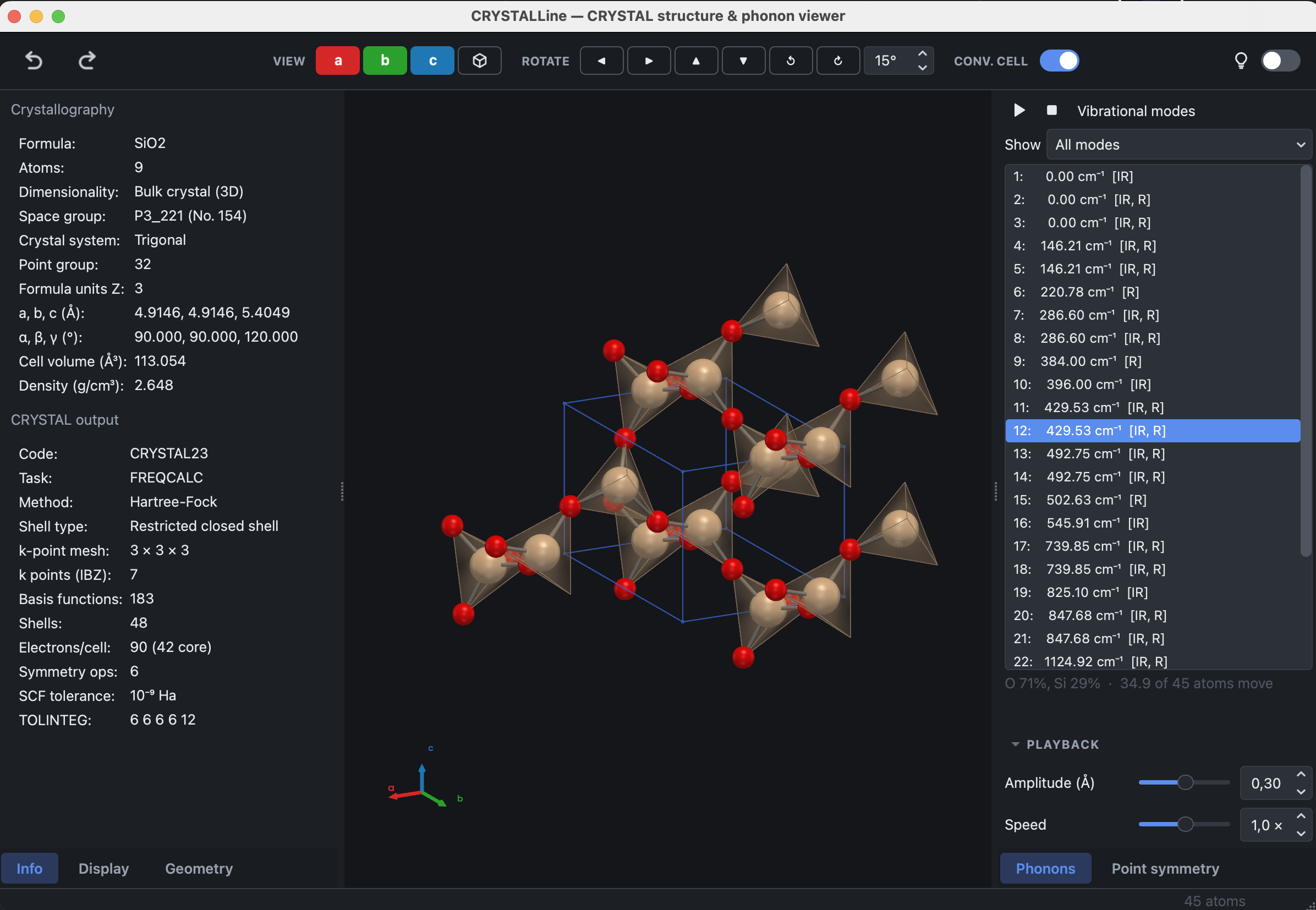
The window is divided into dockable panels:
Position |
Panel |
Contents |
|---|---|---|
Left |
Info |
space group or layer group, lattice parameters, density, and a summary of the calculation |
Left |
Display |
the settings of the 3D view |
Left |
Geometry |
distances, angles, dihedrals and planes |
Right |
Phonons |
the list of vibrational modes and the animation controls |
Bottom |
Plots |
the property plots, in tabs |
Panels can be moved, stacked, resized or closed. View → Panels restores a single panel and View → Restore all panels restores the original arrangement.
Controlling the view#
The structure is rotated by dragging, zoomed with the scroll wheel and translated by dragging with the middle button (or with Shift held down).
The toolbar contains three groups: VIEW, which orients the structure along the a, b or c axis and returns it to a view of the whole; ROTATE, which turns it by a fixed step, 15° unless changed in the adjacent box; and CONV. CELL, which switches between the crystallographic and the primitive cell.
View → Appearance selects the light or dark interface, or follows the system setting.
Next#
The 3D view describes the Display panel, Editing structures the modification of a structure, Symmetry the analysis and reduction of its symmetry, Phonons the vibrational modes, CRYSTAL input builder the preparation of new calculations and Property plots the plotting of the results.